Titanium dioxide electrical conductivity isn’t some abstract lab concept; it's becoming increasingly vital in real-world applications, from advanced sensors to energy storage. For years, we’ve known TiO2 as a brilliant white pigment, the backbone of paints and plastics. But its behavior as a semiconductor – how it conducts electricity under specific conditions – is what's really opening doors. Understanding this property isn’t just for materials scientists anymore; it impacts everything from the efficiency of solar cells to the development of self-cleaning surfaces. We’re seeing a push to leverage this conductivity, particularly in fields demanding robust and adaptable materials.
What’s driving this interest? Simply put, traditional materials are hitting limitations. We need solutions that are durable, cost-effective, and increasingly sustainable. Titanium dioxide checks a lot of those boxes. It's readily available, relatively inexpensive, and remarkably stable. The challenge, and where a lot of the innovation is happening, is in precisely controlling its electrical properties. It’s not a straightforward conductor like copper; its conductivity is highly dependent on factors like crystal structure, doping, and the presence of oxygen vacancies. Getting that control is key.
And honestly, it’s not just about improving existing technologies. The unique characteristics of titanium dioxide’s electrical behavior are enabling entirely new applications we haven’t even fully explored yet. Think about smart coatings that respond to changes in light or temperature, or advanced catalytic systems for environmental remediation. The potential is huge, and the need for practical understanding and implementation is growing rapidly.
Introduction: Understanding titanium dioxide electrical conductivity
We’re moving beyond simply using titanium dioxide as a pigment. Its semiconductor properties – the ability to control its electrical conductivity – are what’s generating serious buzz. This isn’t just theoretical; we're seeing practical applications emerge in areas like photocatalysis, solar energy, and gas sensing. The key is understanding how factors like crystalline structure and doping levels affect how effectively TiO2 conducts electricity. It’s a subtle science, but one with massive implications.
From a practical standpoint, what I've seen on job sites is a growing demand for materials that can do more than just be durable. They need to be smart. They need to react to their environment. Titanium dioxide, with its tunable electrical conductivity, offers a pathway to achieving that kind of functionality. It’s about building intelligence into the materials themselves, reducing reliance on external sensors and controls.
Defining titanium dioxide electrical conductivity
Titanium dioxide electrical conductivity, simply put, refers to how well titanium dioxide allows electric current to flow through it. Unlike metals, which are excellent conductors, TiO2 is a semiconductor. This means its conductivity is intermediate and can be controlled by external factors. It’s not an ‘on’ or ‘off’ switch, but more like a dimmer – we can adjust the flow of electricity by changing things like temperature, light exposure, or by introducing impurities.
The connection to modern industry is significant. Consider the solar cell market. TiO2 is a crucial component in dye-sensitized solar cells (DSSCs) and perovskite solar cells, acting as an electron transport layer. Its conductivity determines how efficiently electrons are collected and transported, ultimately impacting the cell's overall efficiency. Improvements in TiO2 conductivity directly translate to more powerful and cost-effective solar energy solutions.
Beyond energy, think about environmental monitoring. TiO2-based sensors can detect gases like nitrogen oxides and volatile organic compounds. The change in electrical conductivity upon gas adsorption signals the presence and concentration of these pollutants. This opens doors for real-time air quality monitoring and industrial process control.
Core Components Influencing Conductivity
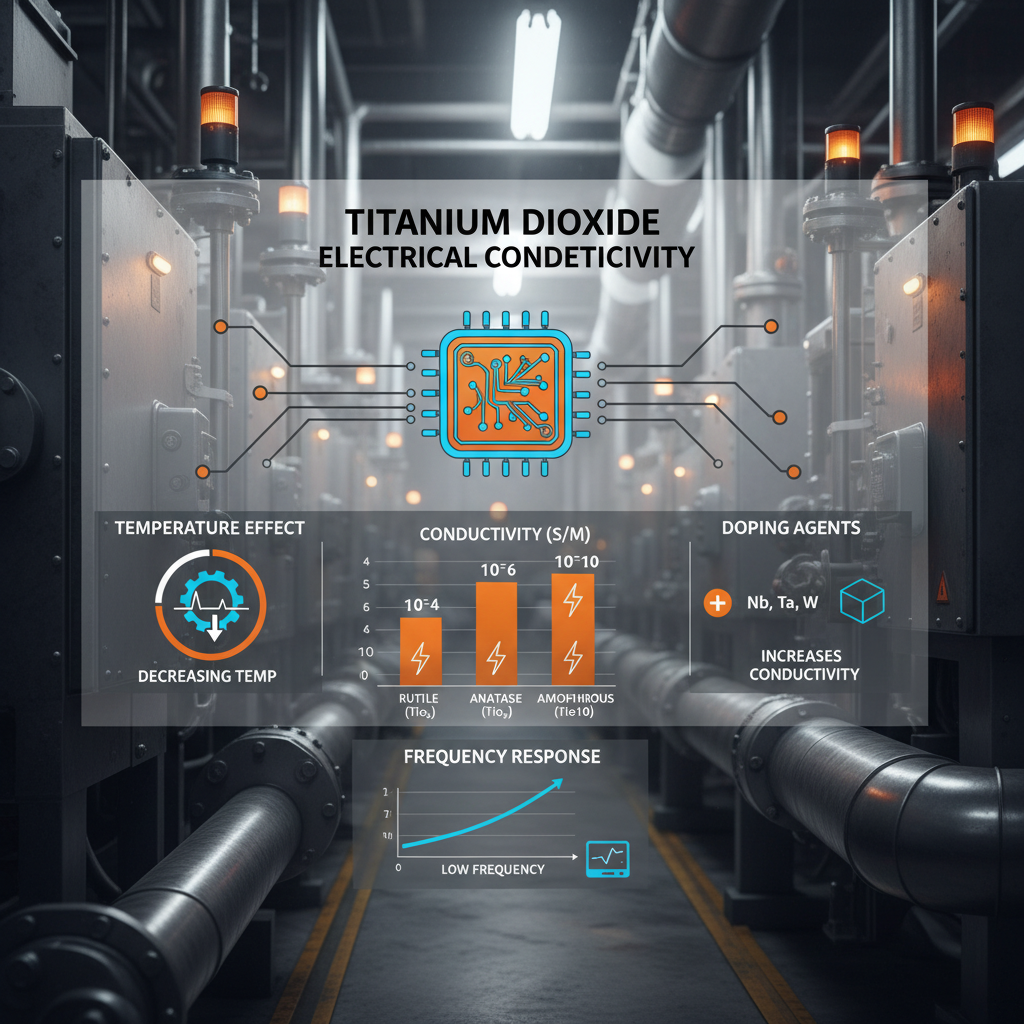
Several factors govern titanium dioxide electrical conductivity. First, the crystalline structure is crucial. Anatase, rutile, and brookite are the three main polymorphs, and each exhibits different conductivity levels. Anatase generally has higher conductivity than rutile. Then you've got oxygen vacancies – defects in the crystal lattice where oxygen atoms are missing. These vacancies act as electron donors, boosting conductivity.
Doping is another critical factor. Introducing impurities like niobium, lanthanum, or fluorine can dramatically alter the conductivity. These dopants create either excess electrons (n-type doping) or electron ‘holes’ (p-type doping), influencing the material’s electrical behavior. It's a careful balancing act; too much dopant can actually reduce conductivity. It's a bit like adding seasoning to a dish – get it just right, and it enhances the flavor, too much and it's ruined.
Finally, surface modifications play a role. Coating TiO2 nanoparticles with other materials or creating heterojunctions can enhance charge separation and transport, improving overall conductivity. It's about creating a synergistic effect where the combination of materials performs better than the sum of their parts.
Global Applications of titanium dioxide electrical conductivity
The applications of controlling titanium dioxide electrical conductivity are expanding rapidly. In the energy sector, we're seeing significant investment in DSSCs and perovskite solar cells, where TiO2 acts as a key component for efficient electron transport. These technologies offer a potentially cheaper and more sustainable alternative to traditional silicon-based solar panels. China is currently leading the charge in perovskite solar cell development.
Environmental applications are also gaining traction. TiO2-based photocatalytic materials are being used for air and water purification, breaking down pollutants in the presence of light. This is particularly important in regions with high levels of air pollution, like India and Southeast Asia. Furthermore, sensors utilizing TiO2’s electrical conductivity are being deployed for gas detection in industrial settings and for monitoring air quality in smart cities worldwide.
TiO2 Conductivity Enhancement Methods
Advantages and Long-Term Value
The benefits of leveraging titanium dioxide electrical conductivity are multifaceted. Cost-effectiveness is a major driver; TiO2 is abundant and relatively inexpensive compared to other semiconductor materials. Sustainability is also key – it's non-toxic and readily recyclable. From a reliability standpoint, TiO2 is exceptionally stable, resisting degradation in harsh environments.
But beyond the tangible benefits, there’s a deeper value proposition. The ability to create smart materials that respond to their environment enhances safety and efficiency. Imagine self-cleaning surfaces on hospitals, reducing the spread of infection, or sensors that proactively detect structural damage in bridges. These are applications that improve quality of life and build trust in the technologies we rely on.
Future Trends and Innovations
We’re on the cusp of some exciting advancements. Research is focused on developing novel doping strategies to achieve even higher conductivity levels. Combining TiO2 with other 2D materials, like graphene, is showing promise for creating hybrid materials with exceptional properties. The rise of artificial intelligence and machine learning is also playing a role, allowing us to optimize TiO2 synthesis and processing for specific applications.
Digital transformation is key here. Think about integrating TiO2-based sensors into the Internet of Things (IoT), creating interconnected networks of smart devices. Furthermore, the push towards green energy solutions will continue to drive innovation in TiO2-based solar cells and photocatalytic systems.
Challenges and Solutions in Utilizing TiO2 Conductivity
Despite the promise, challenges remain. Achieving consistent and reproducible conductivity is a major hurdle. Variations in crystal structure, dopant distribution, and surface defects can lead to unpredictable results. Another issue is the relatively low electron mobility of TiO2 compared to other semiconductors.
To overcome these challenges, researchers are exploring advanced synthesis techniques like atomic layer deposition (ALD) and hydrothermal methods. These techniques allow for precise control over material composition and structure. Furthermore, surface passivation strategies – coating TiO2 with protective layers – can reduce defects and improve stability.
Ultimately, it's about moving beyond trial-and-error and embracing a more data-driven approach. Using computational modeling and machine learning to predict the impact of different processing parameters can accelerate the development of high-performance TiO2 materials.
Summary of Challenges and Potential Solutions for Enhancing TiO2 Conductivity
| Challenge |
Impact on Conductivity |
Potential Solution |
Implementation Complexity (1-10) |
| Crystal Structure Variations |
Inconsistent conductivity due to different polymorphs. |
Controlled hydrothermal synthesis and annealing processes. |
6 |
| Oxygen Vacancy Control |
Difficulty achieving optimal vacancy concentration. |
Precise control of annealing atmosphere and temperature. |
7 |
| Dopant Distribution |
Uneven distribution leads to localized conductivity variations. |
Atomic Layer Deposition (ALD) for precise dopant incorporation. |
8 |
| Surface Defects |
Charge carrier recombination and reduced conductivity. |
Surface passivation with protective coatings (e.g., graphene). |
5 |
| Low Electron Mobility |
Limits the overall current carrying capacity. |
Hybridization with 2D materials (e.g., graphene). |
9 |
| Reproducibility |
Difficulty achieving consistent results across batches. |
Machine learning-assisted process optimization. |
7 |
FAQS
The electrical conductivity of titanium dioxide is heavily influenced by its crystal structure (anatase, rutile, brookite), the presence of oxygen vacancies, the level and type of doping (e.g., niobium, lanthanum), surface modifications, and even the particle size. Controlling these factors is essential to tailor TiO2's conductivity for specific applications. Essentially, it’s about managing the flow of electrons within the material.
Doping introduces impurities into the TiO2 lattice, creating either excess electrons (n-type doping) or electron ‘holes’ (p-type doping). N-type doping, like using niobium, increases conductivity by providing extra electrons. P-type doping, while less common, decreases conductivity by creating electron vacancies. The key is finding the optimal dopant concentration to maximize conductivity without compromising stability.
TiO2 conductivity plays a vital role in dye-sensitized solar cells (DSSCs) and perovskite solar cells, acting as an electron transport layer. It’s also used in gas sensors for detecting pollutants, photocatalytic materials for water purification, and in developing smart coatings with self-cleaning properties. The range of applications is continuously expanding with ongoing research.
Yes, temperature significantly influences TiO2 conductivity. Generally, increasing temperature increases conductivity due to enhanced thermal excitation of electrons. However, very high temperatures can also lead to structural changes or decomposition, so the relationship isn’t always linear. Careful temperature control is often necessary for optimal performance.
Anatase generally exhibits higher electrical conductivity than rutile, although the difference can be influenced by other factors like doping and oxygen vacancy concentration. This is because anatase has a more open crystal structure, facilitating electron transport. However, rutile is often more stable and durable in certain applications.
Surface defects can act as charge carrier recombination centers, reducing conductivity. Passivation techniques, such as coating TiO2 with a protective layer like graphene or applying a thin film of another semiconductor, can minimize these defects. Controlling the surface chemistry during synthesis is also crucial for reducing unwanted defects.
Conclusion
Titanium dioxide electrical conductivity is more than just a material science curiosity; it’s a foundational element in a growing number of innovative technologies. From boosting the efficiency of renewable energy to enabling smarter environmental monitoring systems, understanding and controlling TiO2’s conductive properties is crucial for addressing some of the world’s most pressing challenges. The interplay between crystal structure, doping, and surface modifications provides a powerful toolkit for tailoring TiO2’s performance to specific needs.
Looking ahead, we can expect to see even more sophisticated applications emerge as research continues. The integration of TiO2 with other advanced materials, coupled with the power of AI-driven optimization, will unlock new possibilities for smart materials and sustainable technologies. To learn more about how titanium dioxide can benefit your applications, visit our website: www.watequipments.com.