
ROS8100 Reverse Osmosis Control System China Suppliers and Factory

The ROS-8100 is a professional touch screen reverse osmosis control system from leading China suppliers and factory. It integrates online conductivity monitoring and automated process management for high-precision water purification and desalination.

Product Details

Product Details

Contact Now

Contact Now

Product Details

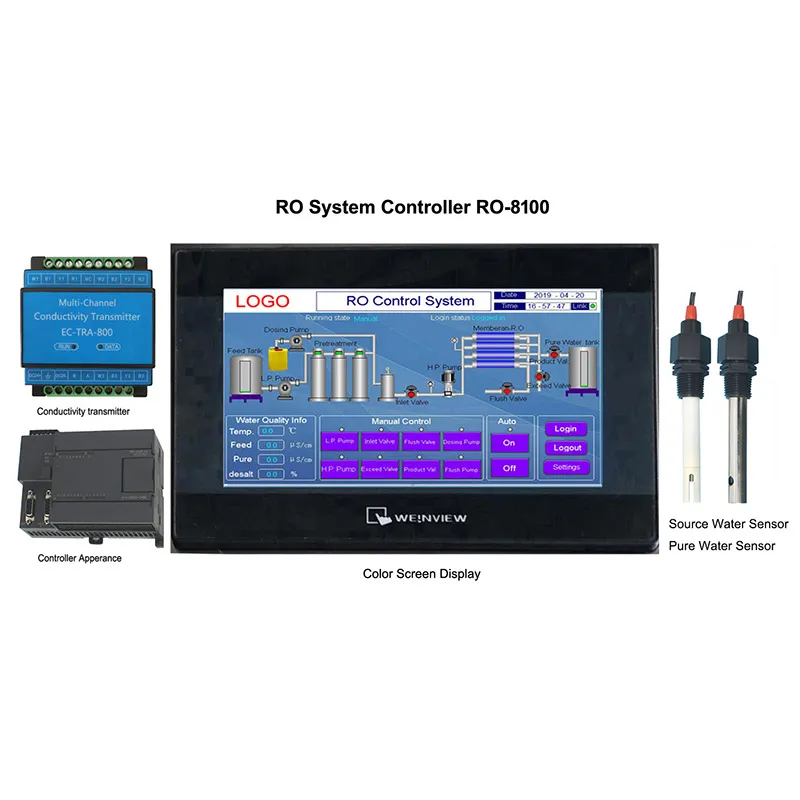
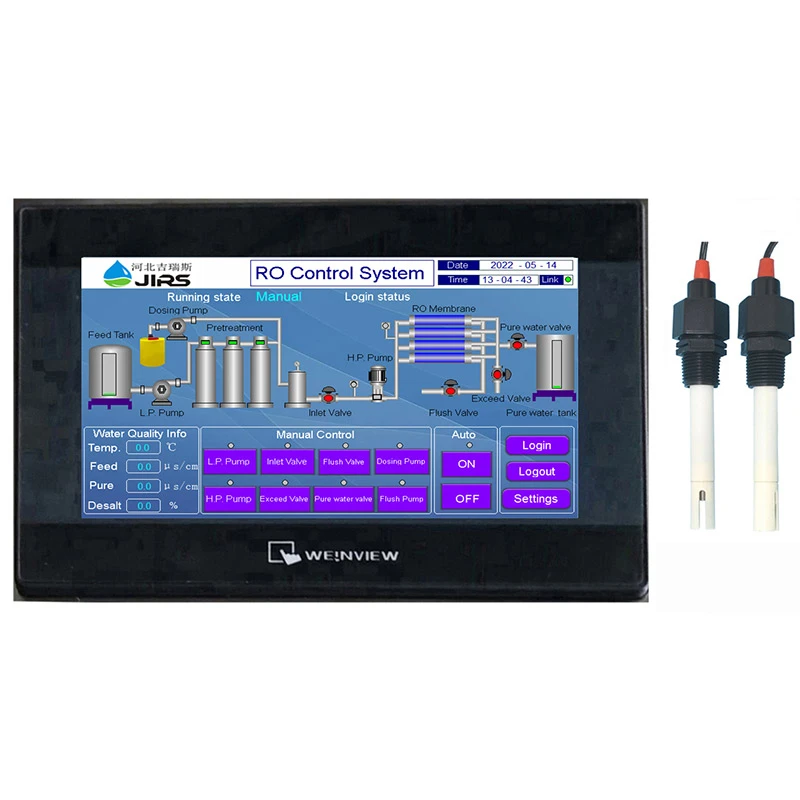
The ROS-8100 is a professional-grade, multi-function Reverse Osmosis (RO) control system designed for high-precision water quality monitoring and automated process management. Featuring an intuitive touch-screen interface and high-speed MCU processing, it integrates real-time conductivity monitoring with comprehensive system control, making it an ideal solution for pure water equipment and seawater desalination units across various industrial sectors.

Engineered for maximum stability and anti-interference, the ROS-8100 supports both single-stage and double-stage RO configurations. By combining PLC logic with a dynamic human-computer interface, the system enables unmanned monitoring and full automatic control of critical parameters, ensuring optimal membrane performance and consistent water purity through a sophisticated digital operation framework.

Detailed Parameters

Source Water Conductivity0~5000μS/cmRO Production Conductivity0~200μS/cm
Temperature Measurement0-60℃Conductivity Sensor Constant1.0cm-1
Power SupplyAC 220V/2APrecision Level1.5 level
Working Pressure0~0.5MpaTemperature CompensationCalculated based on 25℃
Screen Options7" (Standard) / 10" (Optional)Resolution800480 pixels

Key Advantages


High Stability

Utilizes a high-speed MCU computer processing system from the USA for superior anti-interference and reliability in harsh industrial environments.


Unmanned Monitoring

Full automatic system management allows for 24/7 operation without the need for constant manual supervision.


Multi-Stage Versatility

Available in both single-stage and double-stage versions to adapt to different desalination and purification requirements.


Dynamic Visuals

High-resolution touch screen provides real-time process charts and intuitive data visualization for operators.


Precise Monitoring

Simultaneous monitoring of source water and production water conductivity ensures immediate detection of water quality shifts.


Flexible Integration

Supports RS485 communication and standard 4-20mA signals for easy integration into existing factory PLC networks.

Product Gallery

Management Platforms

Process Visualization

Dynamic system flow charts show the real-time running status of every valve and pump via LED indicators.

Automated Flushing

Configurable startup, timed, and interval flushing settings to prolong membrane life and maintain efficiency.

Intelligent Alarming

Instant alerts for low water levels, excessive conductivity, and pump overload to prevent system failure.

Security Access

Multi-level user login system with password protection to prevent unauthorized parameter modifications.

Manual Override

Dedicated manual interface for independent operation of pumps and valves during maintenance.

Multi-Language Support

Interface supports English, Chinese, and Persian to accommodate global operational teams.

Investment Return Comparison

FeatureTraditional ControlROS-8100 System
Labor CostHigh (Manual Monitoring)Low (Fully Automated)
Membrane LifeStandard (Manual Flush)Extended (Timed Flush)
Response TimeSlow (Manual Check)Instant (Real-time Sensor)
Error RateHuman-dependentDigital Precision
Operational RiskHigher Risk of Dry-runIntegrated Pump Protection

Frequently Asked Questions

Q: How does the ROS-8100 ensure the longevity of RO membranes?

The system incorporates automated flushing settings, including startup and interval flushing, which removes accumulated impurities and prevents membrane fouling.

Q: Can the ROS-8100 be integrated into an existing PLC network?

Yes, it features RS485 communication ports and a conductivity transmitter that allows it to interface seamlessly with higher-level industrial control systems.

Q: What protections are included for the high-pressure pumps?

The system includes dedicated input signals for high and low-pressure switches, as well as overload protection, ensuring pumps shutdown immediately during faults.

Q: How is the conductivity sensor installed for maximum accuracy?

Sensors should be installed at the lowest point of the pipe where flow is steady and air bubbles are minimal, ensuring the cell is fully immersed in moving water.

Q: Is the ROS-8100 suitable for seawater desalination?

Absolutely. Its high-range source water conductivity monitoring (up to 5000μS/cm) makes it ideal for seawater and brackish water reverse osmosis units.

Q: What should I do if the conductivity reading shows a large deviation?

Check for incorrect sensor wiring, verify the temperature measurement, inspect the electrode for damage, or check for interference from frequency converters.

Ready to Automate Your Water Purification Process?

Contact Us

Get in Touch

If you are interested in our products, you can choose to leave your information here, and we will be in touch with you shortly.

* Name

* E-mail

Phone

*Message

FAQS


Related Products

right
right
RO Membrane

RO Membrane

PH-6800

PH-6800

WS-9200/9250

WS-9200/9250

RO-8100

RO-8100

RO- 8200

RO- 8200

ORP-6800

ORP-6800

PH/ORP-600

PH/ORP-600

JIRS-803C

JIRS-803C

Related News

right
right
Rotameter FAQ for small-flow measurement in water treatment

Nov.03,2026

Rotameter FAQ for small-flow measurement in water treatment

Learn how a Rotameter measures fluid flow, where it fits in water-treatment and RO systems, and which accuracy, pressure, and float details to review before ordering.

Choosing WS 9100: Application Fit and Specification Checks

Oct.29,2026

Choosing WS 9100: Application Fit and Specification Checks

Evaluate whether the WS 9100 fits your environmental monitoring project. Review power supply options, temperature-controlled storage, sampling method compatibility, and key specifications before purchasing.

PH/ORP-6850 Controller FAQ: Specifications, Configuration Options and Ordering Questions

Oct.23,2026

PH/ORP-6850 Controller FAQ: Specifications, Configuration Options and Ordering Questions

PH/ORP-6850 FAQ: pH 0–14 and ORP ±1200 mV ranges, ±0.02 pH accuracy, isolated 4–20 mA output, relay alarms, power supply options and panel installation.

Guide to Ensuring Water Purity for drinking water tds Monitoring

Jul.01,2026

Guide to Ensuring Water Purity for drinking water tds Monitoring

Ensuring Water Purity: The Ultimate Guide for Drinking Water TDS Monitoring Maintaining high water quality standards is essential for public health and industrial safety. One of the most critical metrics for assessing water purity is Total Dissolved Solids TDS, which represents the combined content of all inorganic and organic substances dissolved in water. Utilizing high-precision equipment for drinking water tds measurement allows facilities to detect contamination and ensure that filtration systems are operating at peak efficiency. In this guide, we will explore the technical aspects of TDS monitoring and how advanced transmitters provide the reliability needed for modern environmental monitoring.

Understanding the Conversion of Electrical Conductivity to TDS

Jun.29,2026

Understanding the Conversion of Electrical Conductivity to TDS

Understanding the Conversion of Electrical Conductivity to TDS In water quality analysis, measuring the purity of a liquid often involves understanding the relationship between electrical conductivity to tds Total Dissolved Solids. While conductivity measures the ability of water to pass an electrical currentwhich is directly influenced by the concentration of ionized substancesTDS represents the total amount of mobile charged ions, including minerals, salts, or metals dissolved in a given volume of water. For professionals in environmental monitoring and water treatment, mastering this conversion is essential for maintaining system efficiency and ensuring regulatory compliance.

Industrial Guide to Electrical Conductivity Salt Water Monitoring

Jun.27,2026

Industrial Guide to Electrical Conductivity Salt Water Monitoring

Understanding Electrical Conductivity Salt Water Monitoring for Industrial Precision In the realm of water quality analysis, measuring the electrical conductivity salt water levels is a critical process for maintaining industrial efficiency and environmental safety. Conductivity serves as a direct indicator of the concentration of dissolved ions, which is essential for industries ranging from desalination plants to chemical manufacturing. Accurate monitoring prevents equipment corrosion, ensures product purity, and supports regulatory compliance. By utilizing advanced instrumentation, operators can achieve real-time insights into salt concentrations, allowing for immediate adjustments in water treatment processes to avoid costly downtime.

Technical Guide to Industrial ec meter circuit Design and Use

Jun.26,2026

Technical Guide to Industrial ec meter circuit Design and Use

Understanding the EC Meter Circuit: The Heart of Water Quality Analysis Electrical Conductivity EC is a fundamental parameter in environmental monitoring, aquaculture, and industrial water treatment. At the core of every reliable measurement device is a sophisticated ec meter circuit , which converts the physical conductance of a liquid into a precise digital reading. Whether you are managing a boilers deoxygenation process or monitoring nutrient levels in hydroponics, understanding how the circuit handles signal amplification and temperature compensation is key to ensuring data accuracy. This guide explores the technical intricacies of EC circuitry and how it integrates into professional water quality controllers.

Professional Guide to drinking water testing for tds and Purity

Jun.25,2026

Professional Guide to drinking water testing for tds and Purity

Drinking Water Testing for TDS: Ensuring Pure and Safe Water Quality Maintaining high water quality is essential for both health and industrial efficiency. When performing drinking water testing for tds , professionals seek to measure the Total Dissolved Solids TDS, which indicates the concentration of dissolved inorganic salts and organic matter in water. Whether you are managing a municipal water plant or a high-precision industrial facility, understanding the conductivity and TDS levels is the first step toward effective water treatment. In this guide, we explore the technical aspects of TDS measurement and the advanced instrumentation required for accurate monitoring.

If you are interested in our products, you can choose to leave your information here, and we will be in touch with you shortly.


en_USEnglish